
Cut marine fuel burn
with physics,
not guesswork.
NAVIMIND computes the lowest-fuel voyage that still hits your ETA window, and prices the EU ETS exposure of every option before you sail. A physics-grounded routing and fuel-efficiency engine for RoPax and deep-sea fleets.
Fuel is the largest
controllable cost at sea.
Now carbon has a price too.
Conservative voyage plans leave fuel on the table
Crews default to design speed on the shortest path. Because power scales with the cube of speed, a small, deliberate speed reduction inside the ETA window can cut burn dramatically, but only if it is computed, not guessed.
EU ETS turned CO₂ into a line item
Shipping now surrenders emission allowances for voyages touching EU ports, phased in through 2024 and 2025. Every tonne of fuel not burned is an allowance not bought, so carbon cost is now coupled directly to routing decisions.
One engine, from sea state to spreadsheet.
It plans the voyage, models the physics behind the burn, and translates the result into fuel tonnes, CO₂, and EU ETS cost, so the trade-off is visible before the lines are let go.
Lowest-fuel routing within an ETA window
NAVIMIND evaluates the full speed-and-heading envelope to find the cheapest path in fuel that still arrives inside a hard ETA window: slow-steam where it pays, hold speed where it must.
objective: MIN_FUELEU ETS exposure, priced per voyage
CO₂ is derived from fuel using IMO-standard carbon factors, then converted to ETS allowances under the current phase-in and intra/extra-EU coverage rules: a euro figure per option, not an afterthought.
CO₂ → allowancesFive objectives, one model
Switch the optimization target without changing the physics: minimize fuel, time, cost, or emissions, or run BALANCED to weigh them together. The same per-leg model scores every candidate edge.
MIN_FUEL · MIN_TIME · MIN_COST · MIN_EMISSIONS · BALANCEDSix vessel archetypes, fully parameterized
RoPax ferry, container feeder, Supramax bulker, Aframax tanker, post-Panamax box ship, and LNG carrier, each built from real naval-architecture parameters rather than generic black-box lookups.
RoPax-first, deep-sea readyPhysics in, euros out.
NAVIMIND models the real physics of the hull, the sea, and the wind using recognized naval-architecture standards, not a black-box estimate. So every plan it proposes is grounded in how your vessel actually behaves, and every number traces back to a published method your team can audit.
Reads the real sea state
live weather, hull, wave & windEvery leg is scored against the conditions it will actually meet: the hull through the water, the waves on the bow, and the wind on the topsides, from live weather along the route.
Finds the cheapest plan that still arrives on time
full speed & heading envelopeNAVIMIND weighs the whole range of speeds and headings open to the voyage and returns the lowest-fuel plan that still lands inside a hard ETA window: no missed schedules to save fuel.
Respects the vessel's limits
within installed powerPlans stay inside what the engine room can actually deliver. NAVIMIND never proposes a speed the vessel cannot hold, so the recommendation is one the crew can sail as-is.
Turns fuel into euros and CO₂
fuel → emissions → EU ETSEach option comes with its fuel tonnes, its CO₂, and its EU ETS allowance cost, so the financial and carbon trade-off is on the table before the lines are let go.
Auditable end to end
traceable to published standardsNo black box. Every figure traces back to a recognized, published method, the kind of provenance a class society, an investor, and a chief engineer can each stand behind.
Numbers you can trace back to a method.
Representative fuel saving
Combining optimal speed selection with weather routing, we estimate a 7–12% fuel reduction against an operator's actual filed plan, while still arriving inside a ±30-minute ETA window.
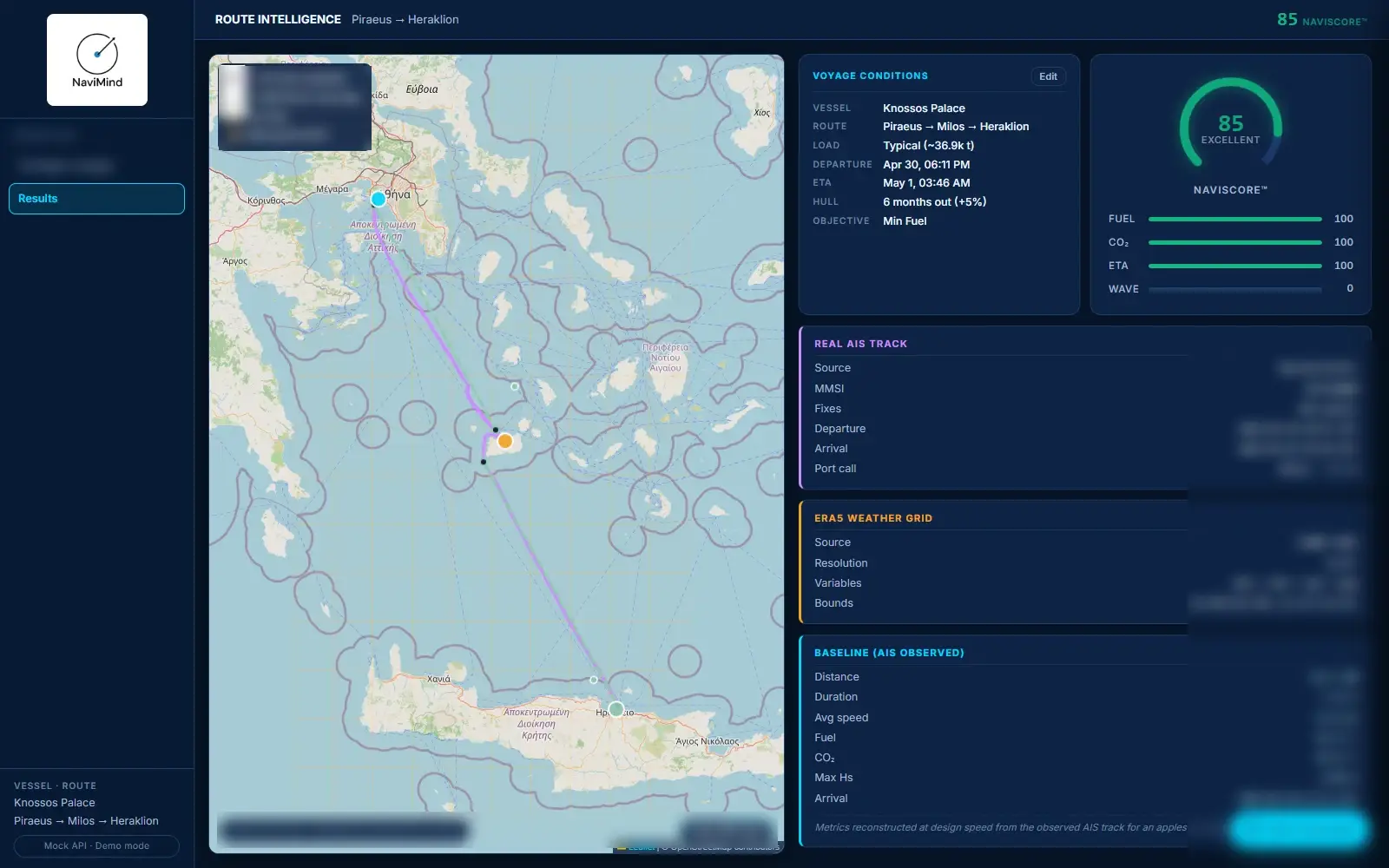
Grounded in peer-reviewed evidence: roughly 4 to 6% from speed optimization and 3 to 5% from weather routing individually (container-ship studies; the IMO cites up to ~10% for some vessels), which overlap rather than simply add when combined. On our Piraeus–Heraklion demo voyage the engine reports a larger figure measured against a full-design-speed baseline — a deliberately conservative "unoptimized" assumption, not an operator's real plan.
A physics core, sharpened by a data moat.
-
Not a black box
Every output traces to a physical parameter and a published method. That is auditable for a class society, an investor, and a chief engineer alike.
-
Live AIS calibration
Continuous AIS ingestion lets the model calibrate per ship from observed behaviour, turning a generic archetype into a vessel-specific efficiency curve over time.
-
RoPax-first, deep-sea ready
We start where schedules are tight and fuel is dominant (short-sea RoPax), then extend the same engine across the deep-sea archetypes it already models.
A working engine, with a clear path ahead.
The engine is live today. From here, the roadmap is about widening coverage and deepening per-vessel calibration, turning a strong model into an ever-sharper one as the data grows.
Interactive routing demo live
Multi-voyage selector, fuel-trend charts, weather overlays, and per-voyage ETS cost against a mock API.
Higher-resolution routing building
Finer routing grids, so the geometric divergence between the baseline and the optimized track becomes visible on the map.
Live AIS + weather automation planned
Automated collection feeding per-ship physics calibration: the data moat that turns archetypes into vessel-specific models.
Per-vessel calibration at scale planned
Tuning each ship to its own observed behaviour, so a generic archetype becomes a vessel-specific efficiency curve.
Deeper fleet coverage planned
Extending the same engine across more vessel classes and trade lanes, from short-sea RoPax out to the deep-sea fleet.
Continuous accuracy gains planned
As the data moat grows, the model keeps sharpening, every voyage observed makes the next prediction tighter.
See the engine run on your route.
Bring a voyage and a vessel class. We will show the baseline, the optimized plan, the fuel delta, and the EU ETS cost side by side, with every number traceable to the model behind it.